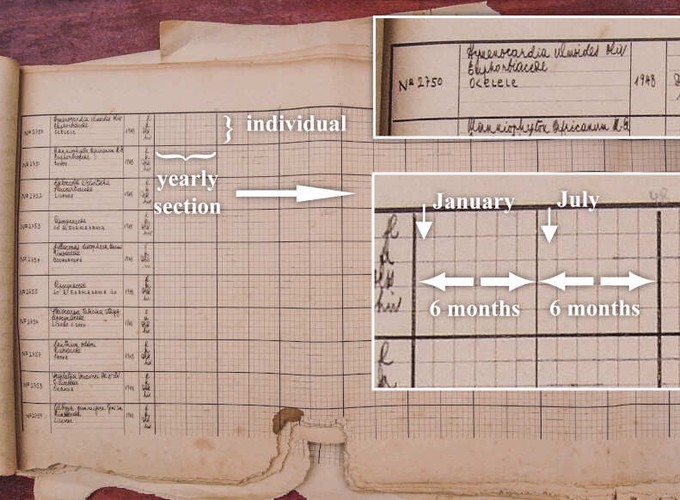
Our recent work (Hufkens et al. 2026), titled “Historical tree phenology data across contrasting sites in the Congo Basin’",is the culmination of a decade of intermittent work on the digitization and transcription of historical phenology observations. The origins of this dataset go back to a field campaign in 2013 to measure forest stands around the Yangambi research station. After the work by Couralet et al. (2010), which recovered phenology data at the Luki research station herbarium dr. Hans Beeckman (then at the Africa Museum) suggested to find out if a similar dataset existed at the Yangambi herbarium, and what its overal condition was.
At the time the Yangambi herbarium was in dire conditions, with a toppled tree having destroyed the roof putting collection materials at risk. In collaboration with the herbarium director and local collaborators an effort was made to safeguard the historical phenology data through ad-hoc digitization. All summary tables and a part of the original notes were digitized. However, transcription was postponed given the size and labour intensity of such an effort.
Fast forward to 2016, when I was working at Harvard on phenology using camera based indicators, collaborator dr. Margaret Kosmala was using citizen science on Zooniverse to explore the potential of citizen science in combination with camera based data. Being involved in this project made me aware of the potential of citizen science. I quickly realized the potential for transcribing the phenology tables which were digitized three years earlier, given a good workflow.
Luckily, at the time the Zooniverse citizen science project builder was just launching. Where the platform previously only hosted project which they curated themselves they were expanding into a platform where any scientist could start a project. This timing provided a way to transcribe the hard to read phenology data using crowd sourcing in a self-curated project. With the help of Margaret and some time out of my normal schedule, for which I’m grateful to dr. Andrew Richardson, the Jungle Rhythms project was built.
The Jungle Rhythms project was launched spring 2016, gathering some additional press exposure through a piece in The Guardian. The last community transcription was finished a little over a year later. However, with no formal money earmarked for the post-processing of the raw transcription into a usable form and little time in my schedule the project once more was put on hold. Between 2018 and 2024 I worked on-and-off on completing the project. In this time frame I wrote the formal processing routine to convert all locations (coordinates) in the images into usable phenology metrics. Finally, in 2024 I first started compiling a public version of the data, including the necessary meta-data to provide a broader context. Key support was given by dr. Steven Janssen, dr. Piet Stoffelen, dr. ir. Elizabeth Kearsley in the verification of species names.
Looking back on this project it has taught me some important lessons. First of all, you don’t need much money (not including personal time) to do impactful science. The project was mostly run as a side project along my other academic research. Although formal funding would have been appreciated, creativity goes a long way if you have time. Second, much of this research was also influenced by key people along the way, especially early on, notably dr. Hans Beeckman for pushing the effort to look for the data, dr. Margaret Kosmala for putting citizen science on my radar, dr. Andrew Richardson for providing the time for side projects, and dr. Hans Verbeeck for long-time continued support in this and other tropical ecology research projects. Finally, this initial effort gave rise to subsequent projects not in the least my Belgian Science Policy Office funded “Congo basin eco-climatological data recovery and valorisation (COBECORE)”, and an adjacent EU Marie Skłodowska-Curie Actions funded project. This further led to exploring topics such as handwritten text recognition, on which I still provide consulting services. This underscores that small (side) projects can be leveraged into larger ones, and such small projects can have a long tail with broad impacts.
References
Hufkens, K., Kearsley, E., Stoffelen, P. et al. Historical tree phenology data across contrasting sites in the Congo Basin. Scientific Data (2026). https://doi.org/10.1038/s41597-025-06542-z
Couralet, C., Sterck, F. J., Sass-Klaassen, U., Van Acker, J. & Beeckman, H. Species-specific growth responses to climate variations in understory trees of a central african rain forest. Biotropica 42, 503–511 (2010).